How Much Money Do You Need to Study in Australia — And How Much Can You Earn There

English courses in Australia cost between AUD 190 and AUD 450 per week. Gold Coast and Adelaide have the best prices. Include in your budget: OSHC (AUD 52–67/month), enrolment fee (AUD 200–300) and accommodation (AUD 150–350/week). Working on a student visa, you can earn between AUD 2,100 and AUD 2,700 per month to cover part of the costs.
How Much Does It Cost to Study English in Australia in 2026: Prices by City, Duration, and OSHC Included
In summary: English courses in Australia cost between AUD 190 and AUD 450 per week. Gold Coast and Adelaide have the best prices. Include in your budget: OSHC (AUD 52–67/month), enrollment (AUD 200–300), and accommodation (AUD 150–350/week). Working with a student visa, you can earn between AUD 2,100 and AUD 2,700 per month to cover part of the costs.
"How much does it cost to study English in Australia?" is the most frequent question we receive here at Yooz Study. The honest answer: it depends — on the city, the school, the type of course, and the duration. But in this guide, you will find real prices, city comparisons, and everything you need to build a realistic budget for your exchange program in 2026.
What does the cost of studying English in Australia include?
Before talking numbers, it's important to understand that the total cost of an English exchange goes beyond school tuition. The main items are:
Course tuition (the biggest cost)
School enrollment fee
OSHC — compulsory health insurance for student visas
Accommodation (the second biggest cost)
Cost of living (food, transport, leisure)
Airfare and visa fees
Let's detail each one.
English course prices by type in 2026
Australian English courses (ELICOS — English Language Intensive Courses for Overseas Students) are offered in various modalities. The prices below are references for 2026:
Course Type | Price per week
General English: AUD 200 – AUD 320
Academic English: AUD 280 – AUD 380
IELTS Preparation: AUD 280 – AUD 420
Cambridge Preparation: AUD 300 – AUD 450
Business English: AUD 300 – AUD 450
Prices vary between schools and may have discounts for early bookings or longer periods.
Prices by city: where is English cheaper?
The city where you study greatly impacts the cost — both of the school and the cost of living.
Gold Coast
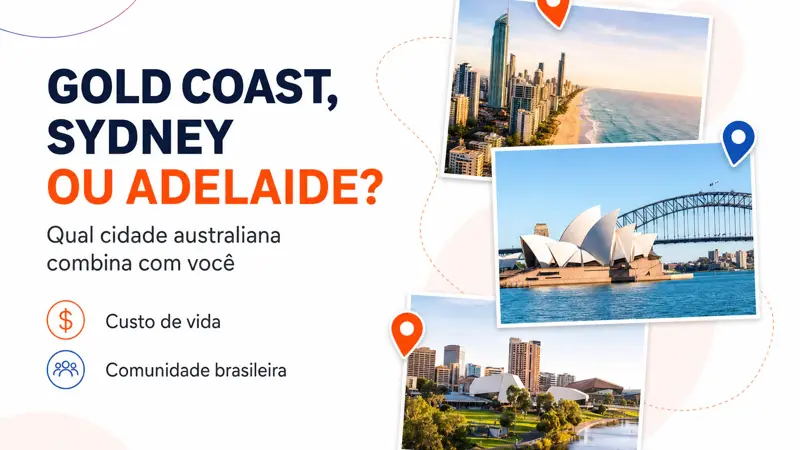
The favorite city for Brazilians has school prices below the national average. Many renowned schools charge between AUD 200 and AUD 280 per week for General English. The cost of living is also lower than Sydney and Melbourne, making Gold Coast the best value-for-money destination for most Brazilian students.
Brisbane
Similar prices to Gold Coast, with excellent transport infrastructure and a good offer of schools. Average between AUD 210 and AUD 300 per week.
Adelaide
The most economical city in the country for exchange programs. Tuition around AUD 190 to AUD 270 per week, with the lowest cost of living among major Australian cities.
Sydney
The country's economic capital has the highest prices. Expect to pay between AUD 270 and AUD 380 per week at major schools. The cost of living is about 30% higher than Gold Coast.
Melbourne
Similar to Sydney in school prices (AUD 260 – AUD 370 per week) and high cost of living. Worth it for those who want the experience of Australia's cultural capital.
OSHC: the compulsory health insurance
Every student with a student visa (subclass 500) is legally required to have OSHC (Overseas Student Health Cover). The five licensed insurers and their approximate monthly prices in 2026:
Insurer | Monthly cost (individual student)
ahm: ~AUD 52
nib: ~AUD 57
BUPA: ~AUD 63
Medibank: ~AUD 64
Allianz Care: ~AUD 67
For a 6-month course, OSHC represents between AUD 310 and AUD 400 in total — a cost many forget to include in their budget.
Important: With a Working Holiday visa (462), you do not need OSHC but must contract adequate health insurance for your stay.
Course duration: which is the most recommended?
The right duration depends on your current English level and your goals:
4 to 8 weeks: for those who already have intermediate English and want a quick immersion or practice before working.
10 to 20 weeks: the most common choice among Brazilians. Sufficient to go from basic to functional fluency for the job market.
24 weeks or more: for those starting from scratch or wanting to achieve advanced English for VET or university courses.
Budget simulation for 12 weeks in Gold Coast
To give you a real idea, here is a simulation of 3 months of English course in Gold Coast:
Item | Estimated Cost
General English Course (12 weeks × AUD 240): AUD 2,880
Enrollment Fee: AUD 250
OSHC (3 months): AUD 165
Share House Accommodation (12 weeks × AUD 220): AUD 2,640
Food (3 months): AUD 1,200
Transportation: AUD 300
Leisure and unforeseen expenses: AUD 600
Approximate Total: AUD 8,035
This value does not include airfare (on average BRL 8,000 to BRL 12,000 round trip) or visa fees.
How long does an English course last and what is ideal for you?
The right duration of an English course depends on your current level and what you want to achieve. Here is a practical guide:
4 to 8 weeks — for those who already have intermediate English
Ideal for quick immersion, adapting to the Australian accent, and reinforcing vocabulary before starting work. Many Brazilians who arrive with a WHV opt for this initial period.
10 to 20 weeks — the most popular among Brazilians
The most frequent choice for those starting from basic or intermediate and wanting to achieve functional fluency for the Australian job market. By the end of 20 weeks of total immersion, most students are able to communicate confidently in everyday and professional situations.
24 weeks or more — for those who want advanced English
Necessary for those planning to take a VET course or enroll in an Australian university. Academic English, IELTS Preparation, and Cambridge Preparation are the most suitable courses for this objective.
Costs that people often forget in their budget
Many Brazilians arrive in Australia with a budget calculated only for school and accommodation — and are surprised by unforeseen expenses. See the most common:
Enrollment fee: between AUD 200 and AUD 300 at most schools. Often negotiable if you book in advance or through an agency like Yooz Study.
Airfare: generally between BRL 8,000 and BRL 14,000 round trip depending on the time of year. Bookings 3 to 4 months in advance are usually cheaper.
Visa fee: check the current value on the official Home Affairs estimator — it is updated annually.
Arrival expenses: mattress, bedding, kitchen utensils, mobile phone SIM card, and the first few days of food before the first salary. Reserve AUD 300 to AUD 500 for this.
Visa renewal: if you plan to stay more than 12 months, include the renewal fee in your budget.
Passport: check if your passport has a minimum validity exceeding the period you plan to stay — obtaining or renewing one in Brazil costs between R$ 400 and R$ 500 and can take time.
How to save money during your exchange program in Australia
With planning, it is possible to reduce costs without giving up a good experience:
Housing: living in a share house away from the center (with good public transport) is always cheaper than living in the heart of the city. In Gold Coast, for example, the rent difference between Surfers Paradise and neighborhoods like Robina or Southport can be AUD 50 to AUD 100 per week.
Food: cooking at home is the biggest possible saving. Supermarkets like ALDI and IGA have more affordable products than Woolworths and Coles. Shopping at the local Farmer's Market on Saturday is a good idea for fresh fruits and vegetables.
Transportation: if you live near school or work, a bicycle is an excellent and free alternative — the Australian climate favors it. Public transport cards (Go Card in Queensland, Opal in Sydney) have an automatic discount compared to a single ticket.
Mobile phone: Australian prepaid operators are much cheaper than Brazilian post-paid plans. Kogan, Amaysim, and Boost offer plans with 20-40 GB of data for AUD 20 to AUD 30 per month.
Leisure: beaches, parks, trails, and Australian nature are free and inexhaustible. Many cultural festivals and events in Australia are free or low-cost.
Is an exchange program in Australia worth it in 2026?
The burning question — and the answer is yes, for those who plan well.
The exchange rate of the Australian dollar (AUD) against the Brazilian real makes the initial investment significant. But it's important to consider the other side of the equation: with the Australian minimum wage of AUD 26.44/hour (Fair Work Commission, July 2026), a student working 20 to 25 hours per week generates a monthly income of AUD 2,100 to AUD 2,700. Even with Australian living expenses, there's a significant surplus compared to what is earned in Brazil.
For those thinking beyond the exchange program — about permanent residency, an international career, and quality of life — Australia is currently one of the countries with the best return on investment in a migratory process.
Can I work while studying to help with costs?
Yes — and that's one of the great advantages of an exchange program in Australia. With a **student visa (subclass 500)**, you can work up to 48 hours per fortnight during term time. With the minimum wage of AUD 26.44/hour, a part-time job earns between AUD 2,100 and AUD 2,700 per month — enough to cover a good portion of living costs.
How does Yooz Study help with choosing a school?
Yooz Study works with over 40 accredited partner schools across Australia. Our team knows each school personally, knows which ones have the best structure for Brazilians, and negotiates special conditions that are often not available directly.
Want to receive a personalized quote with the best options for your profile? Fill out the form on the website, and our team will get back to you within 24 hours.